Unico Age Verification
Privacy and accuracy with just a selfie.
You don't have to sacrifice conversion to comply with the new Digital ECA law.
We've developed the only deterministic and fully private age verification solution that, with just a selfie, can confirm a user's legal age with 99.9% accuracy.




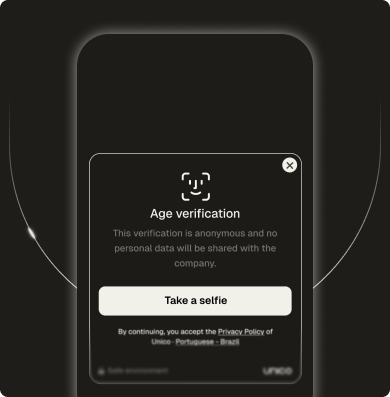
Adapt to Law 15.211/2025 without having to choose between conversion and security
Replace estimates with deterministic responses using Unico's age verification solution. With just a selfie, we validate the user's legal age with 99.9% accuracy.
We guarantee maximum security: the biometric data requested for age verification is deleted after validation, returning only the response needed for your journey: "Yes," "No," or "Inconclusive."

Why choose Unico's solution?
Unico exists to foster trust between people, businesses, and governments, collaborating to build a world that is not only safer but also free from bureaucracy.
We actively participate in discussions about the Digital ECA law alongside regulatory bodies, companies, and society. Our solution was designed to combine the protection of minors with the efficiency that diverse markets demand.

The global standard for identity. Chosen by companies that scale without limits.

How does Unico's age verification work?

Each person has a combination of physical characteristics that makes them unique in the world.
Facial biometrics uses technology to identify, map, and translate these features into numerical data. Unico's database recognizes over 170 million people worldwide and 9 out of every 10 Brazilian adults.
Through proprietary technology, we are able to identify the biometrics with 99.9% accuracy and return a "Yes," "No," or "Inconclusive" response to the platform. No need to fill in additional information and no data sharing.
Does Unico's age verification guarantee my privacy?
Yes. The selfie is used only to validate whether the person is of legal age. We send only a "Yes," "No," or "Inconclusive" response about the user's legal age to the platform or final website, without sharing any other information. After this process, the data is deleted from Unico's database.
What is the difference between age verification and age estimation?
Unico's age verification system bases its response on the user's actual date of birth, meaning we do not estimate age through facial characteristics. This ensures that the platform or website does not lose customers or fall out of compliance with the law due to estimation errors.